
Real screenshots. Real engine. Launching soon.
Everything below is the actual app running the actual deterministic engine — not mockups. The public launch is close; here is what you are waiting for.
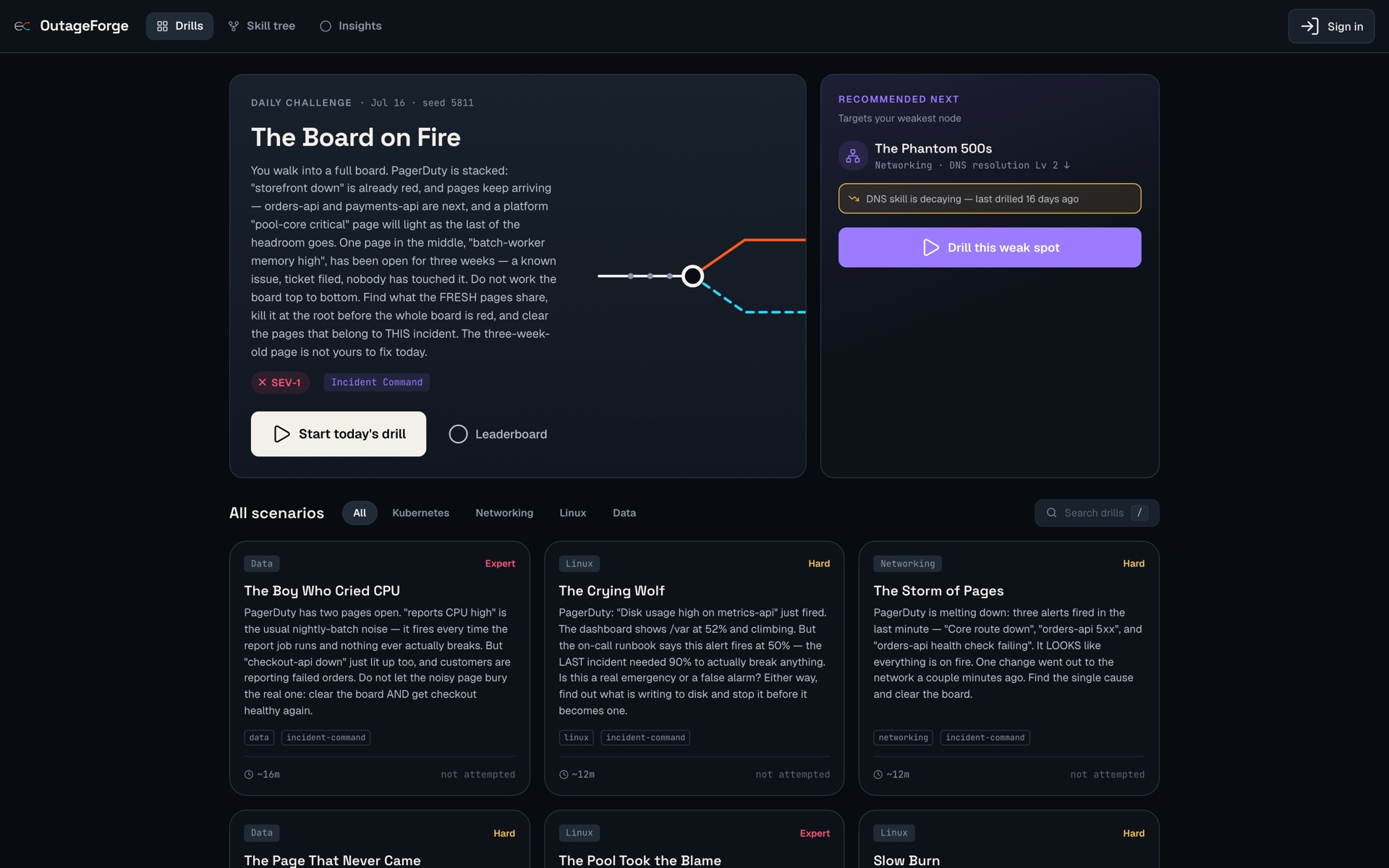
A daily challenge with one seed for everyone
Every day, one incident — same seed, same physics, every responder. Compare honestly. Behind it: a library of 89 authored drills across five domains, and a recommendation engine that targets your weakest, most-decayed skill.
- Daily challenge: deterministic pick, identical for every player
- Recommended-next drills aimed at your weakest node
- 89 authored incidents — Linux, Kubernetes, Networking, Data, Incident Command
- Difficulty bands from Starter to Expert
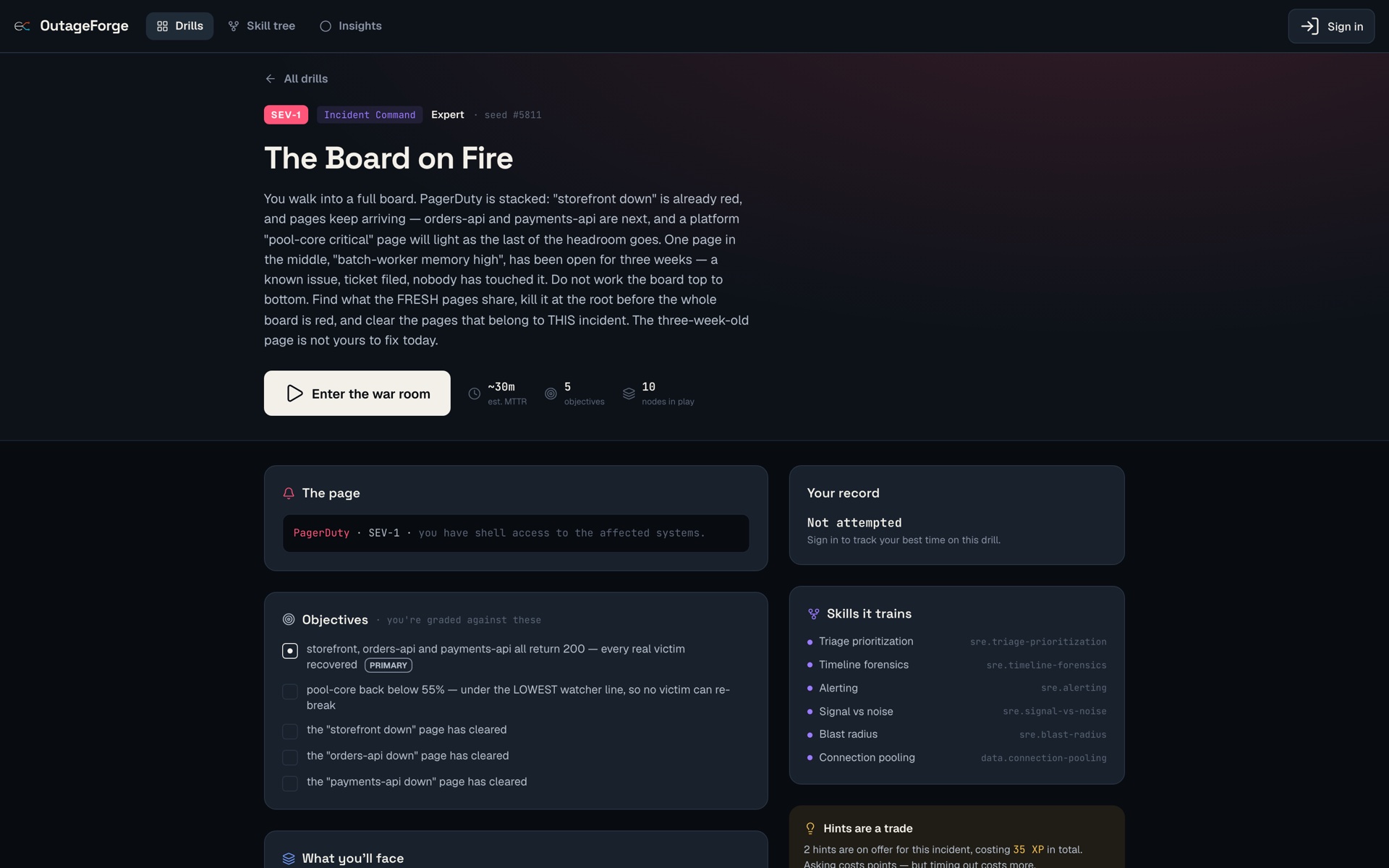
Know the stakes before you drop in
Every drill opens with the page as it would land: severity, the story so far, the objectives you will be graded against, and the exact skills it trains. Hints exist — but they are a trade, priced in XP.
- Objectives up front — you are graded against them, no surprises
- Skill nodes each drill trains, mapped to the tree
- Hints cost XP — asking is a decision, like real escalation
- Your record on the drill: best time, attempts
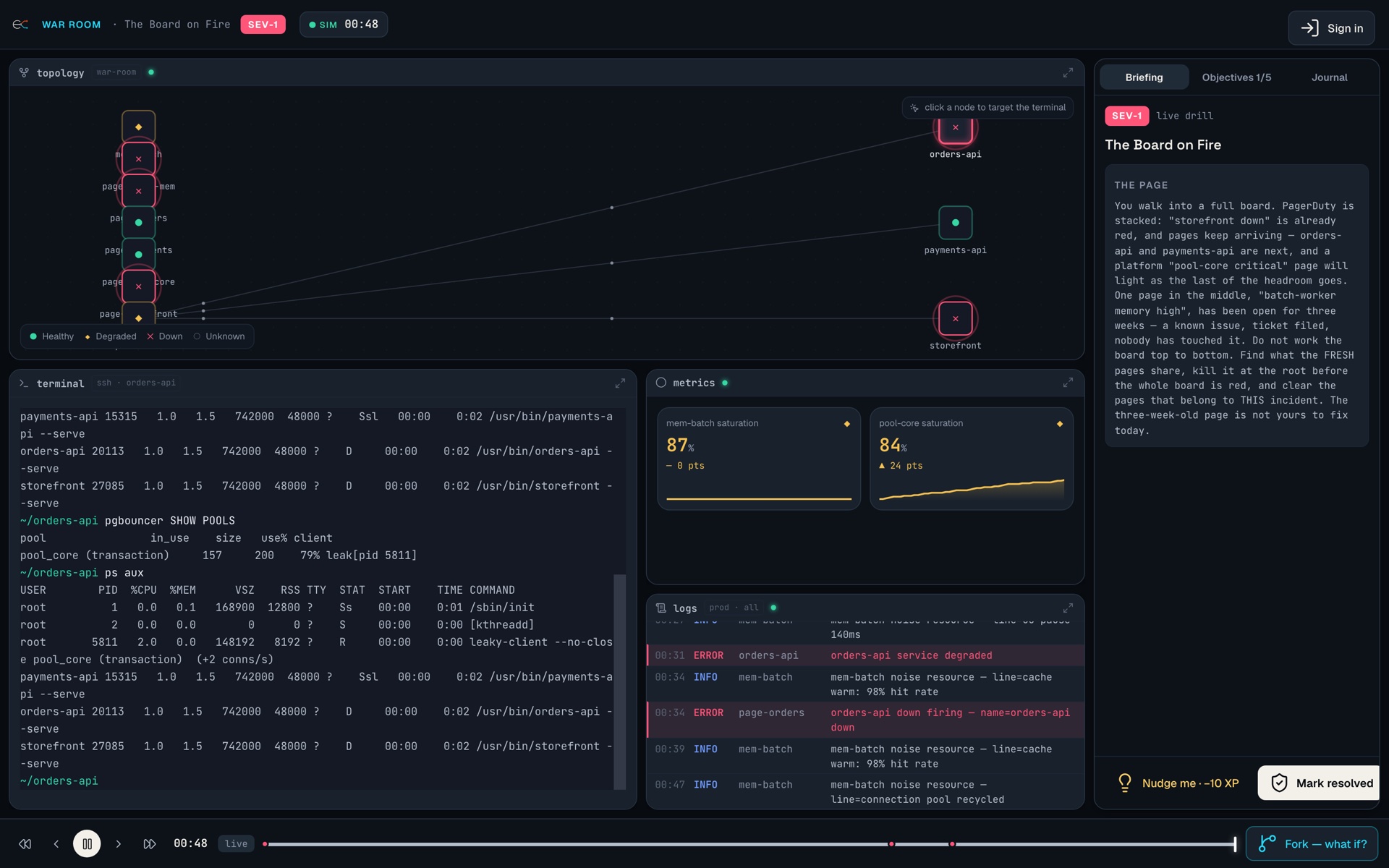
A live incident that fails in front of you
A real terminal — real grep, awk, jq over a projected filesystem — against a topology that degrades as the incident physics play out. Pages fire, metrics climb, logs stream. And the scrubber at the bottom lets you rewind the incident while it is still running.
- One terminal, host-retargetable, with genuinely modeled tools
- Live topology, saturation metrics, and log streams — all read from the same world state
- Alerts fire from the same signals the grader reads — nothing is scripted theater
- In-session time travel: scrub back, inspect the past, fork a what-if
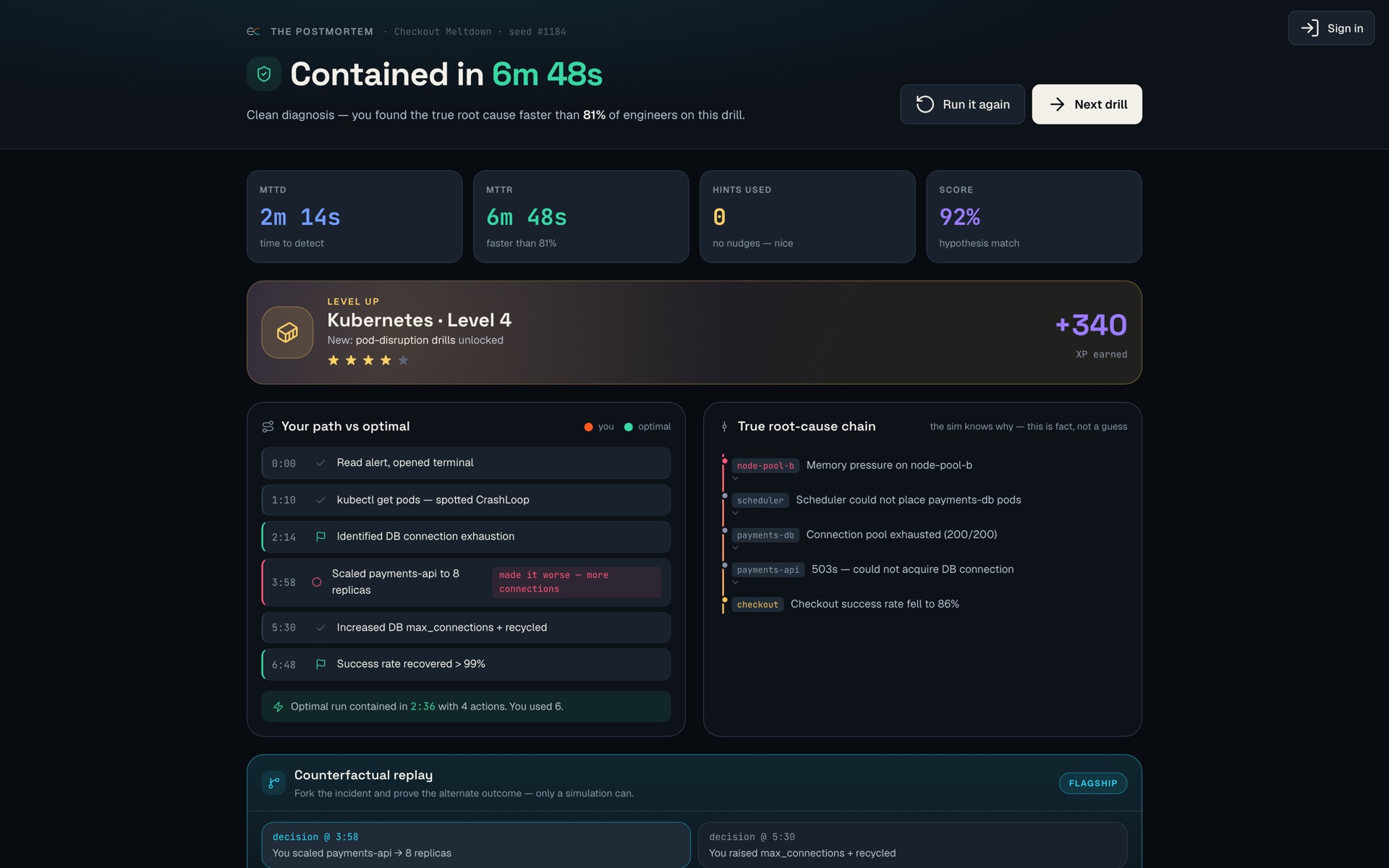
Counterfactual replay — prove the better path
The flagship. When the incident ends, the sim shows the true root-cause chain (it knows — this is fact, not a guess), your path against the optimal one, and then the thing no real lab can do: fork the incident at any decision and replay the alternate outcome, deterministically.
- MTTD, MTTR, hints used, hypothesis-match score
- Your path vs optimal, decision by decision — including the ones that made it worse
- The true root-cause chain, derived from the engine, not inferred
- Fork any moment and PROVE what the better call would have saved
An RPG skill tree that decays like real skills do
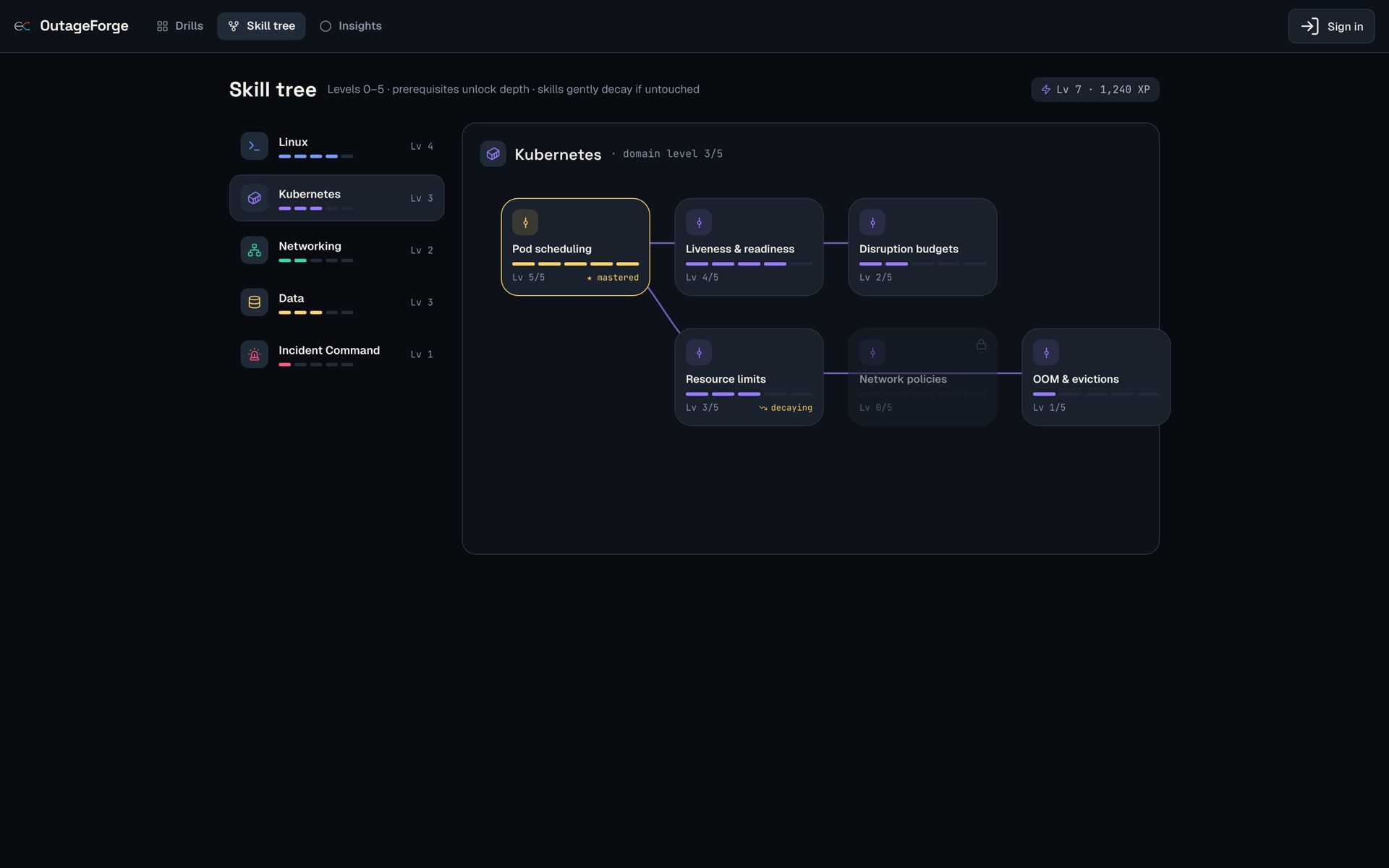
Five domains, each a graph of real competencies. Drills feed XP into the exact nodes they exercise; prerequisites unlock depth; mastery is earned across distinct scenarios, not by grinding one. Leave a skill untouched and it decays — and the recommendation engine notices.
- Linux, Kubernetes, Networking, Data, Incident Command
- Per-node levels with mastery stars and prerequisite gating
- Skills decay if untouched — decayed nodes resurface as recommended drills
- Breadth gates: high levels demand range, not repetition
The trends that tell you it is working
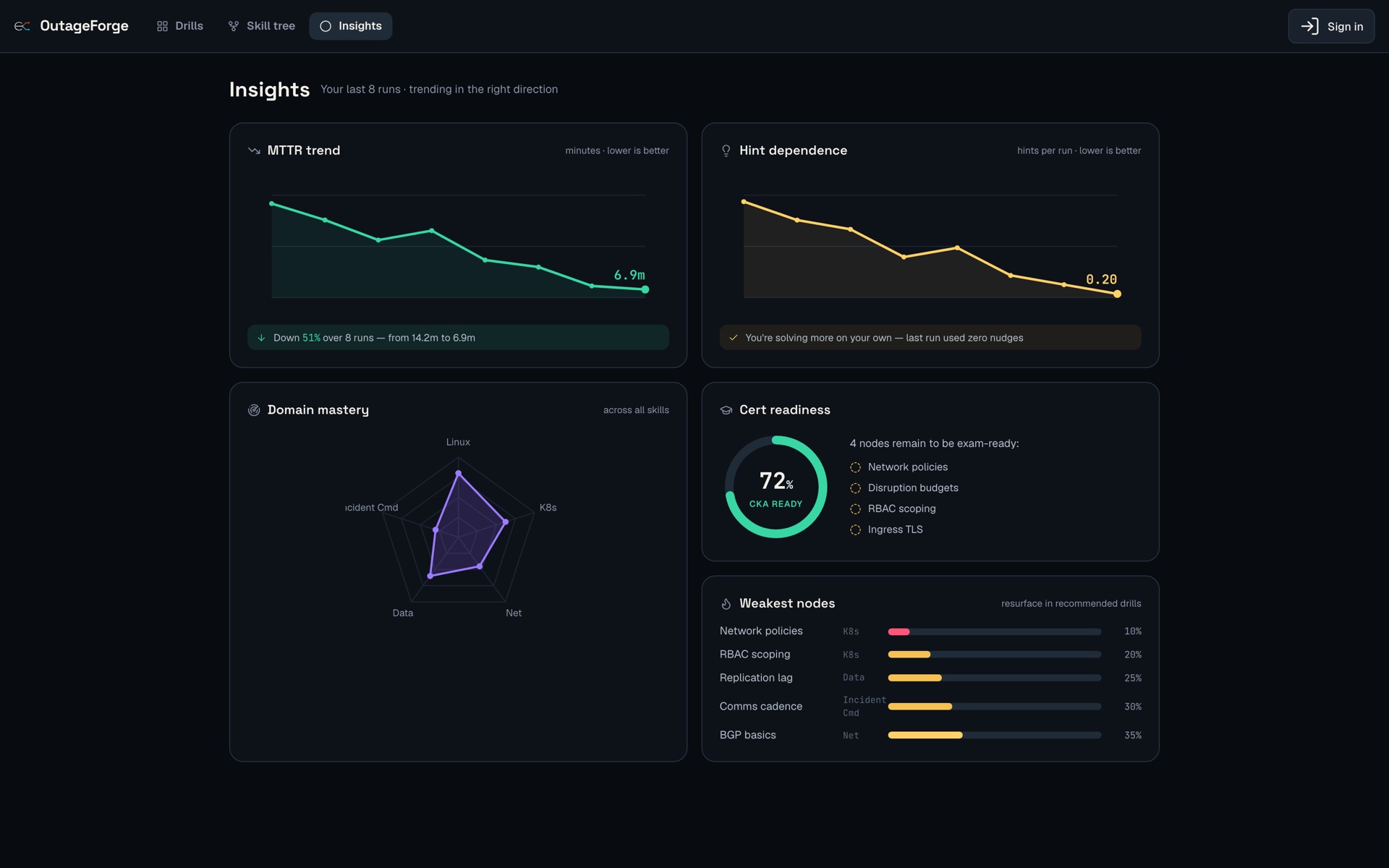
MTTR trending down. Hint dependence trending to zero. A mastery radar across all five domains, cert-readiness tracking, and your weakest nodes — which feed straight back into what the launcher recommends next.
- MTTR trend across your runs — the number that matters
- Hint dependence: are you solving more on your own?
- Domain mastery radar + weakest-node ranking
- Cert-readiness tracks (CKA, RHCSA, and more)
Deterministic to the bit
Every drill runs on an input-sourced simulation engine: seeded randomness, integer state, golden-hash verified across JS engines in CI. That determinism is what makes the counterfactual honest — a fork is a proof, not an estimate. The terminal runs real ripgrep, coreutils, awk, and jq compiled to WebAssembly over a projected filesystem.
It is almost here.
Free daily challenge at launch. On-Call Pro at $12/mo when billing opens.
See the plans